










The future of banking from a single source
Low interest rates, competition, digitalization and regulation all shape banking and create considerable turbulence in the banking industry. msg group has three key banking experts: msg for banking ag, msg Rethink Compliance and Finnova, all of whom have the expertise and experience required to help banks master the challenges of today, while preparing for those of tomorrow.
msg for Banking
msg for banking rethinks banking and offers our customers smart, innovative and platform-based digitized solutions from a single source. For more than 100 years, we have been supporting our customers in optimizing their business success and helping them to transform their business in line with constantly changing financial markets. As a market leader in bank management and regulatory reporting and a provider of high-quality consulting solutions, we are a reliable partner at our customers' side.
In the areas of Strategy & Business Models, Finance, Risk & Compliance, Capital Markets, Payments, Digital Transformation & IT and Financial Artificial Intelligence, we are ideally equipped to identify and evaluate upcoming challenges and implement them together with our customers. Solutions in the areas of digitalization and cloud are just as much a part of this as a solution for the overall bank management of the future.
ORRP - the Open Risk and Reporting Platform Architecture - is our answer to the consistent and transparent methods and processes in bank management required by European and national supervisory authorities. ORRP combines the technical added value of the solutions THINC (bank management) and BAIS (reporting) on one platform and thus enables the efficient linking of reporting and risk controlling, for example in the normative approach of ICAAP/ILAAP. In this form, ORRP is unique in Germany.
Finnova develops product-based front-to-back office solutions for banks. With their proprietary product, “Finnova Banking Software”, the Swiss company helps banks and BPO providers efficiently process their standard banking functions.
The consulting and technology company msg Rethink Compliance is a specialist in the area of Anti-Financial Crime and helps customers to implement their compliance strategies to combat money laundering, terrorist financing and corruption.
Insights & Trends
Topics
Products & Related Services
Banking.Vision Events
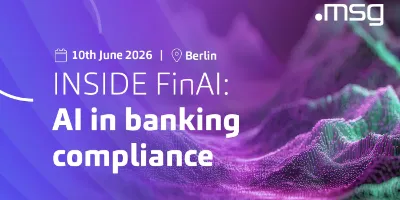
AI offers great potential for banks' compliance departments, but is often associated with uncertainty. At INSIDE FinAI, AI experts from academia and industry will use specific use cases to show you how the sensitive area of compliance can leverage the advantages and potential of AI – securely and in compliance with regulatory requirements.
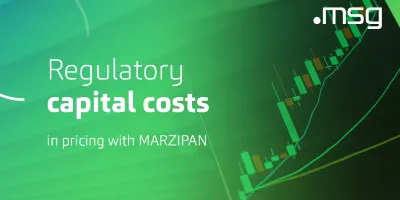
As part of a live demo, you will get to know the EKKKSA performance level of our MARZIPAN solution and its contribution to taking into account the EBA guidelines on lending and monitoring (EBA/GL/2020/06). Using a calculation example, you will see directly in the software how the economic and regulatory capital costs are calculated in the contribution margin scheme in MARZIPAN and learn from our experts how the bottleneck principle of economic and regulatory capital can be taken into account in the preliminary calculation.