













From reactive systems to autonomous helpers: How Agentic AI independently controls and optimises processes
Agentic AI enables AI systems to not only generate responses, but also actively perform tasks, control tools, prepare decisions and orchestrate complex processes. While classic AI was purely reactive, Agentic AI defines a new class of systems that can plan, act, review and iteratively optimise.
The combination of large language models, external tools, domain-specific logic and autonomous planning creates a new form of digital workforce. We develop agent systems that reliably, securely and explainably support business-critical processes, from knowledge research to the execution of complex end-to-end processes.
Your contact

Agentic AI systems as a modular construction system
Dimensions of Agentic AI systems
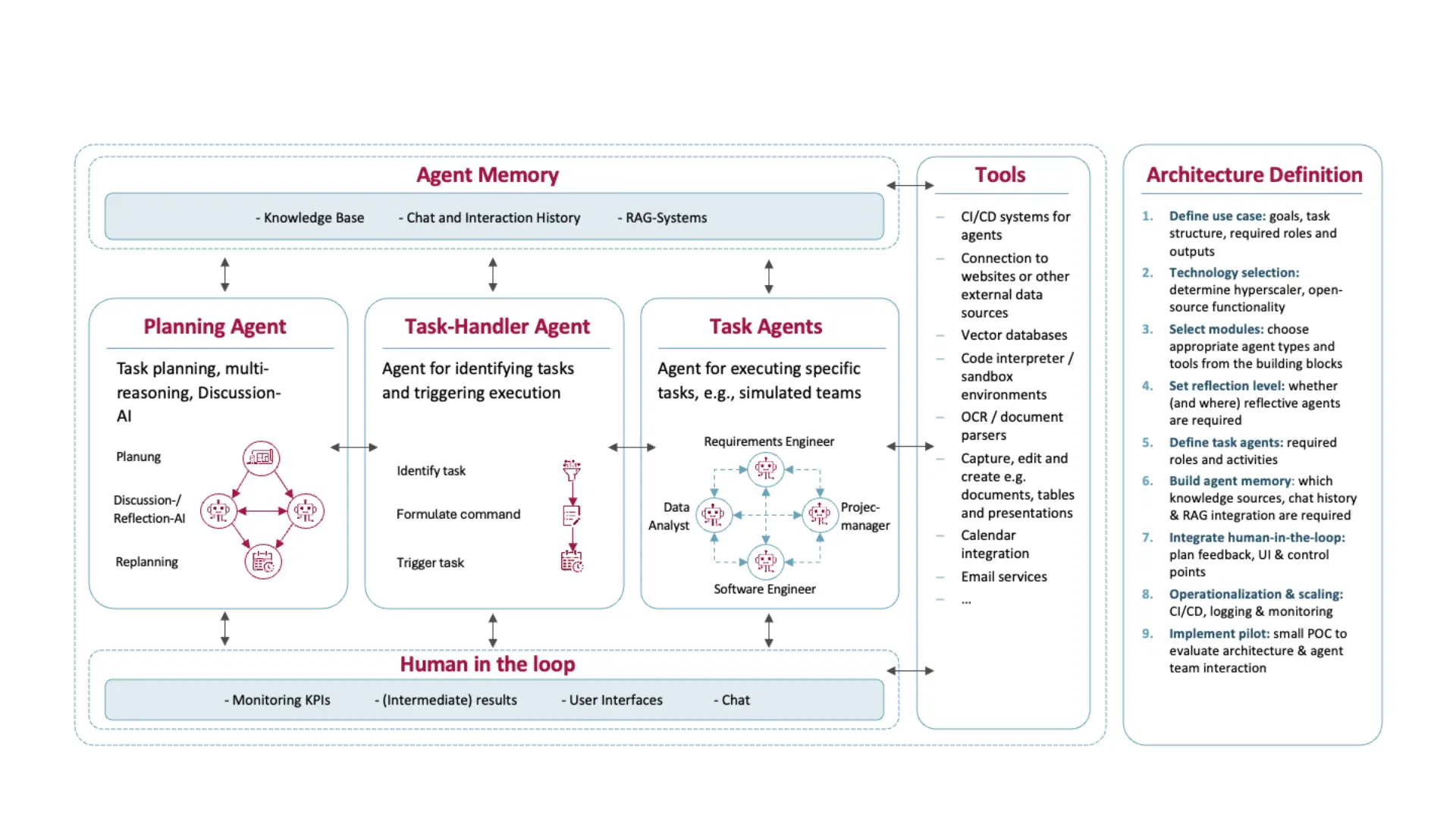
An Agentic AI solution rarely consists of a single agent, but rather of several specialised roles that interact with each other. Orchestration determines how tasks are divided, coordinated and prioritised, for example between the planning agent, analysis agent and execution agent.
We design clear handover points, control mechanisms and communication rules to ensure that agents work together reliably. At the same time, we create guardrails that minimise risks and prevent errors.
The success of an agent system depends heavily on the choice of underlying models and tools – such as GPT models, open source models, vector storage, knowledge graphs or internal APIs. Depending on the use case, we define which combination of language models, retrieval, toolkits or specialist models is used.
Our focus is on optimally balancing cost, security, speed and result quality. We regularly evaluate new models and architectures in order to take advantage of technological developments at an early stage.
Effective agents require precise instructions. Prompting is not just the formulation of a command; it includes role description, context management and rule-based restrictions.
We develop systematic prompt frameworks that enable agents to automatically break down complex tasks into smaller steps and process them logically. With structured prompts, memory concepts and reusability, we increase stability, predictability and accuracy.
Agentic AI opens up new possibilities. But also new risks. That's why we rely on architectures with clearly defined scope for action, safety filters and auditable decision-making processes. We use role-based agent systems (e.g. supervisor agent, tool agent, validator agent) to mitigate wrong decisions at an early stage.
At the same time, we implement mitigation strategies such as action review loops, confidence scores and fail-safes to ensure controllable system behaviour. Our approach maximises the ability to act while ensuring complete security.
During operation, agents must be monitored in a similar way to traditional ML models, but with additional requirements. We establish telemetry for actions, tool usage, costs, deviations and decision quality.
Through automated tests, benchmarks and behaviour logs, we can detect early on when an agent is ‘hallucinating’, performing unnecessary steps or working inefficiently. Guardrails ensure that actions always remain within defined limits.
Agent systems require their own operating models. In addition to classic model management (MLOps), a new layer is emerging: AgentOps. This includes versioning agent roles, monitoring tool chains, evaluating agent decisions, and controlled rollout of new behaviour profiles.
We combine proven MLOps practices with new tools for agent testing, simulation, and traceability. This creates a stable, documented, and secure lifecycle for agentic AI systems.
Our range of services
- Architecture & design of agent systems
- Development of multi-agent workflows (planning, execution, control)
- Integration of external tools, APIs and enterprise systems
- Development of prompt frameworks & safety mechanisms
- Setup of monitoring, LLMOps & AgentOps
- Secure deployment in Azure, Databricks, Kubernetes and other platforms
Results & added value
- Automated end-to-end processes instead of isolated AI functions
- Significant reduction in manual tasks
- Improved speed and scaling of complex knowledge work
- Higher quality through validation and security mechanisms
- Future-proof architecture that grows with new models and tools