















Using artificial intelligence to understand visual data and leverage it to add value – from analysis to practical solutions.
Computer vision is the ability of machines to understand and analyse visual information and make decisions based on it. It forms the basis of many modern applications, from quality control in manufacturing and automated document analysis to visual anomaly detection in infrastructure monitoring.
As an IT consultancy, we develop robust, scalable and traceable AI solutions that efficiently convert image data into usable information. We combine deep learning, edge AI concepts and explainable AI to ensure that every system not only works accurately, but is also explainable and verifiable.
Success story
Learn more about a successful application of AI in practice:
➡️ Smart Fleet Köln – KI zur Erkennung von Straßenschäden (only available in german)
Your contact

Dimensions of computer vision systems
Every Computer Vision project starts with the data. We support the structured acquisition, enrichment, and labeling of large image datasets — from defining relevant classes to ensuring annotation quality. Our focus is on preventing bias that can arise from incomplete or unbalanced datasets. This ensures that models make robust decisions, regardless of environment, lighting conditions, or perspective.
Choosing the right architecture is crucial. We develop and evaluate models for classification, segmentation, object detection, or tracking depending on the use case. We rely on modern deep-learning frameworks and integrate pre-trained models to shorten development cycles. Through transfer learning and continuous retraining, we adapt models to domain-specific requirements.
A trained model is only as good as its continuous monitoring. In production environments, data structures, lighting conditions, or object properties change — known as “data drift.” We establish monitoring pipelines that automatically detect deviations and feed feedback loops into the training process. This ensures stable performance and enables early detection of misclassifications.
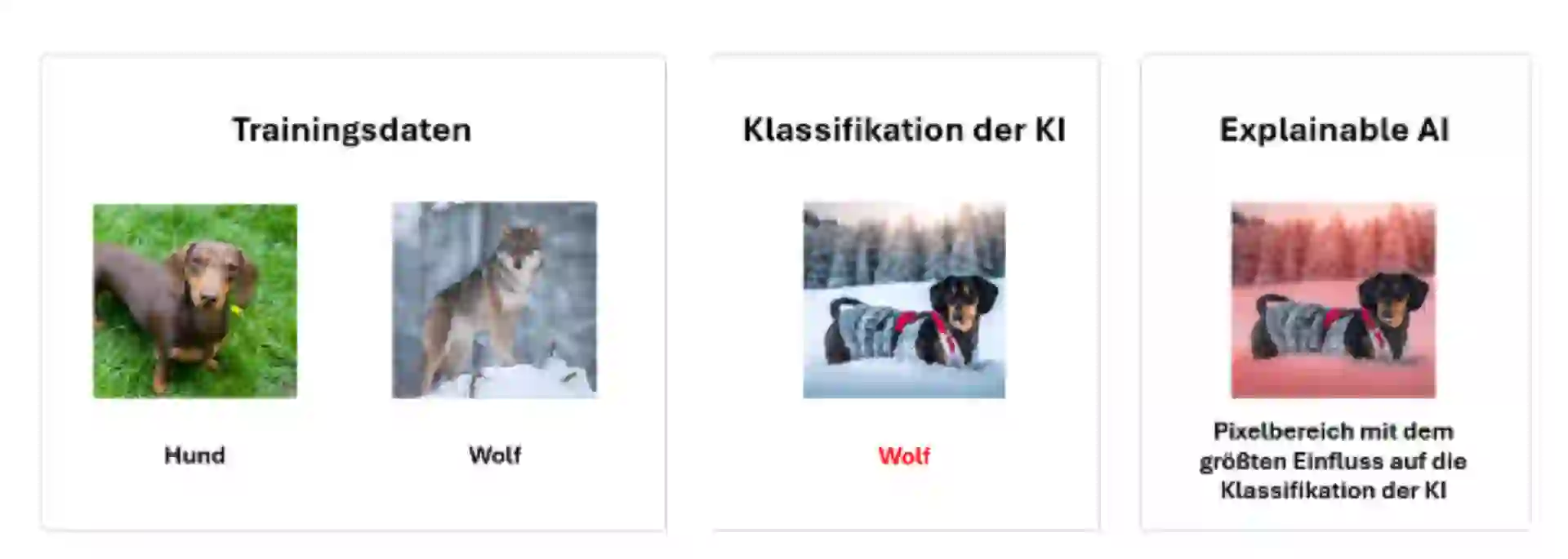
Explainable AI ensures that AI decisions remain understandable, even in Computer Vision projects. A classic example: A model is trained to distinguish between dogs and wolves but unconsciously learns to classify animals based on their background (grass vs. snow) instead of their visual appearance.
With our approach, we analyze which pixel regions have the greatest influence on a decision using heatmaps and Grad-CAM — as shown in the example below. This allows us to detect false learning patterns early and prevent model drift before it impacts productive operations.
Our Service Offering
- Development and implementation of Computer Vision solutions using modern deep-learning frameworks
- Integration into existing platforms and processes (e.g., cloud, edge, or on-prem environments)
- Setup of automated monitoring pipelines to ensure quality
- Consulting on data quality, annotation, and governance in the CV context
- Implementation of explainable-AI mechanisms for traceability and auditability
Results & Added Value
- Precise, explainable detection and classification
- Reduction of manual inspection effort and errors
- Early detection of data or model drift
- Increased transparency and trust in AI-supported decisions