



AI as a Driver of Efficiency for Routine Regulatory Tasks
Organizations have been facing steadily increasing regulatory pressure for many years. New regulatory requirements, extensive audit requests, growing documentation obligations, and continuous compliance and evidence requirements place a significant burden on specialist teams across many industries.
Particularly affected are areas such as:
- Information security
- Compliance
- Governance
- Risk management
- Internal audit
- Outsourcing management
- Regulatory transformation programs
Many activities within these functions are highly repetitive in nature:
- Audit questions must be analyzed and answered.
- Regulatory requirements must be mapped against existing policies.
- Gap analyses must be conducted.
- Control evidence must be identified and evaluated.
- Risks must be classified and prioritized.
Although these activities require subject matter expertise, they often follow recurring cognitive patterns. This is precisely where modern AI assistance systems create new opportunities to provide structured support for professional processes.
Why traditional automation often reaches its limits
Traditional automation solutions perform particularly well in clearly defined, rule-based, and highly structured processes. Many regulatory activities, however, only partially meet these criteria.
Audit and compliance processes are often:
- Document-centric
- Language-driven
- Context-dependent
- Interpretive in nature
- Highly reliant on expert judgment
The challenge therefore lies less in processing structured data and more in systematically analyzing professional and regulatory content.
For example, audit preparation frequently requires:
- Interpreting regulatory requirements and audit questions
- Identifying appropriate evidence
- Evaluating existing controls
- Verifying consistency across documentation
- Identifying potential weaknesses or deficiencies
To date, these activities have required significant manual effort from experienced professionals.
The real value of modern AI lies not primarily in “knowledge“
In public discussions, the value of Large Language Models (LLMs) is often reduced to their general "world knowledge." However, for many regulatory processes, the true value lies elsewhere.
Modern LLMs are capable of:
- Analyzing complex texts in a structured manner
- Comparing information across multiple sources
- Identifying inconsistencies and deviations
- Deriving professional and contextual relationships
- Classifying information
- Performing assessments against predefined criteria
This makes LLMs particularly well suited for recurring cognitive tasks that have traditionally been difficult to automate.
The primary value is not generated through individual prompts, but through structured analytical approaches in which AI models are systematically applied to clearly defined professional objectives and assessment criteria.
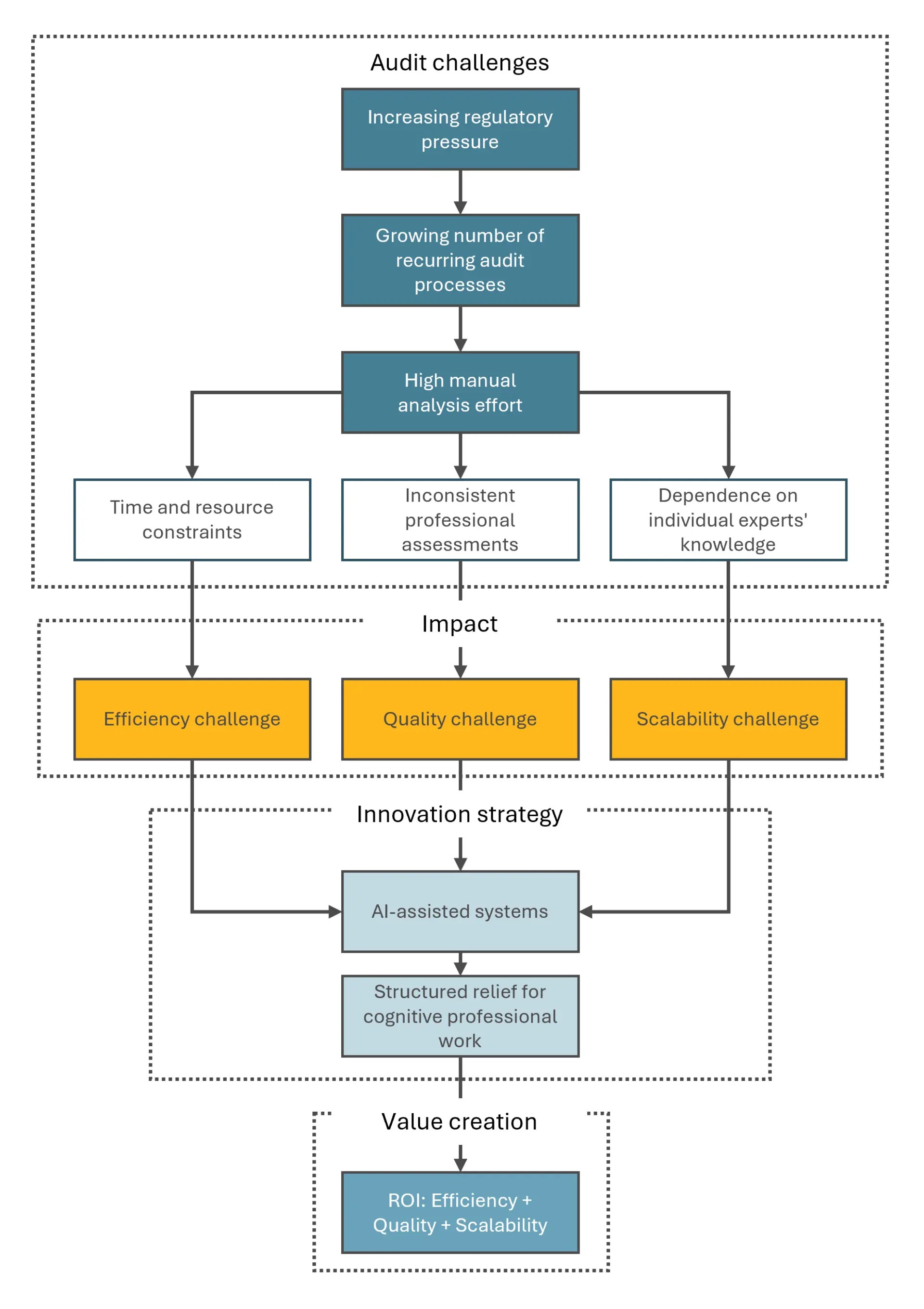
Figure 1: AI as cognitive support
From single prompts to structured AI assistance systems
The effective use of AI in regulatory processes differs significantly from simple chatbot applications.
The focus is instead on structured AI assistance systems that break complex tasks into multiple transparent and traceable processing steps.
A typical analysis process may include:
- Decomposing regulatory requirements into individual control or compliance requirements
- Classifying relevant subject areas
- Analyzing existing policies and supporting evidence
- Performing semantic comparisons between requirements and existing controls
- Identifying potential gaps or deviations
- Assessing business and regulatory relevance
- Prioritizing identified risks
- Aggregating findings into management and audit perspectives
Through iterative processing and repeated analytical cycles, even large-scale assessment and review activities can be supported efficiently.
Traceability as a critical success factor
Transparency is a fundamental prerequisite for the productive use of AI systems.
The key advantage of structured AI assistance systems therefore lies not only in speed, but also in the traceability of each processing step.
When:
- Assessment methodologies are documented,
- Intermediate results remain visible,
- Conclusions are reproducible, and
- Applied criteria are transparent,
accountability can continue to reside clearly with employees and the organization itself.
In this context, AI does not replace professional decision-making. Instead, it significantly enhances the analytical and processing capabilities of experienced specialists.
Particularly in regulatory environments, this creates a practical middle ground between fully manual execution and non-transparent end-to-end automation.
Significant potential for recurring regulatory activities
The greatest opportunities arise wherever organizations face:
- Large volumes of documentation
- Recurring review and assessment logic
- Standardized evaluation patterns
- Extensive comparison and reconciliation activities
Typical examples include:
- Audit preparation
- Gap analyses
- Compliance reviews
- Control effectiveness assessments
- Policy and standards alignment reviews
- Risk assessments
- Third-party assessments
- Regulatory self-assessments
In many of these areas, AI can:
- Reduce processing times
- Improve consistency
- Eliminate knowledge silos
- Accelerate preliminary analyses
- Increase the scalability of regulatory processes
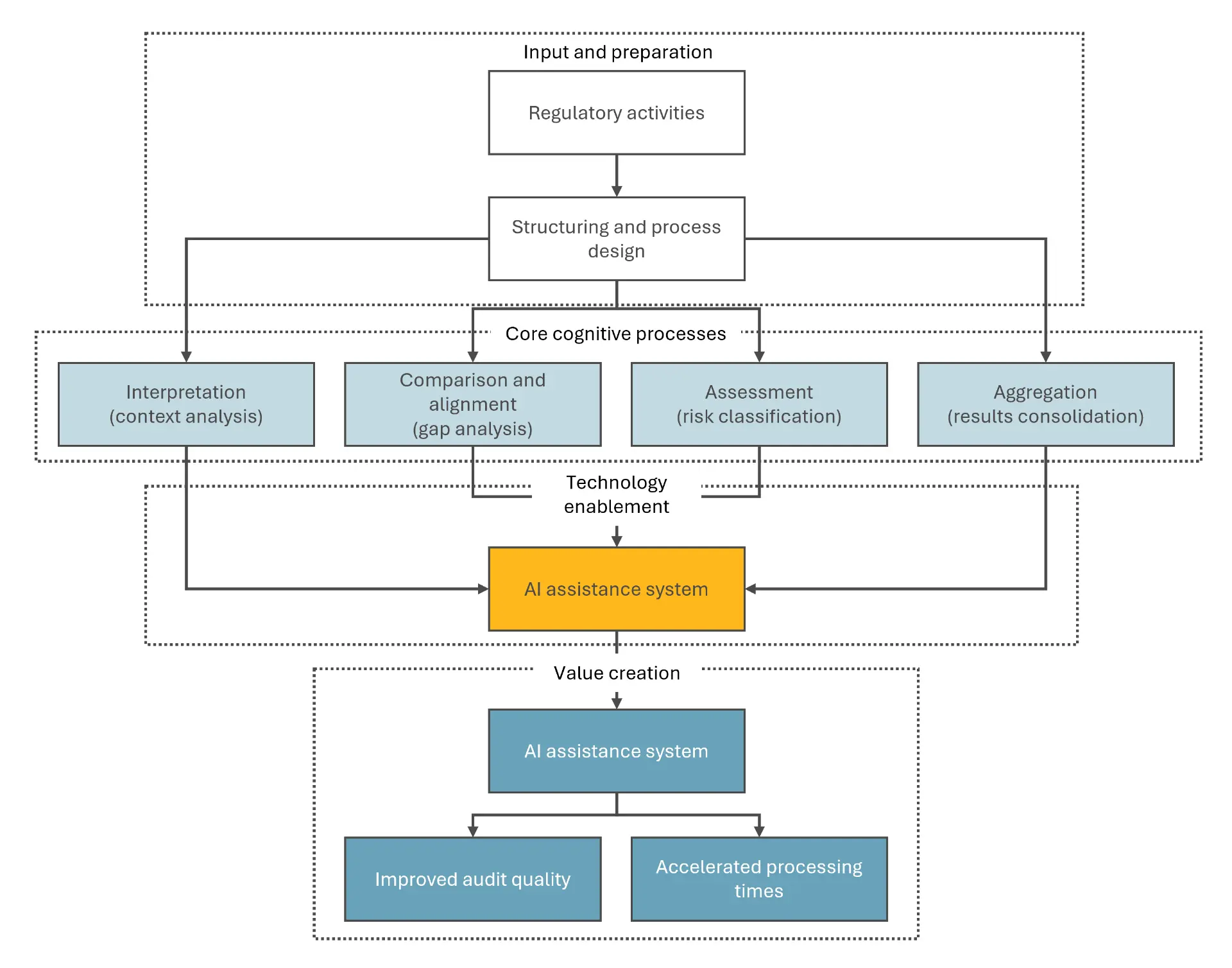
Figure 2: Many regulatory tasks follow similar patterns
Economic benefits extend beyond time savings
The benefits of AI-powered assistance systems are often reduced to direct efficiency gains. The Key benefits include:
- Faster audit and assessment cycles
- More consistent evaluations
- Earlier identification of potential weaknesses
- Reduced operational workload for subject matter experts
- Improved scalability of regulatory requirements
- Lower coordination and communication effort
- Greater reusability of professional assessments and analysis results
Against the backdrop of continuously increasing regulatory requirements, these benefits can have a substantial impact on organizational efficiency, quality, and responsiveness.
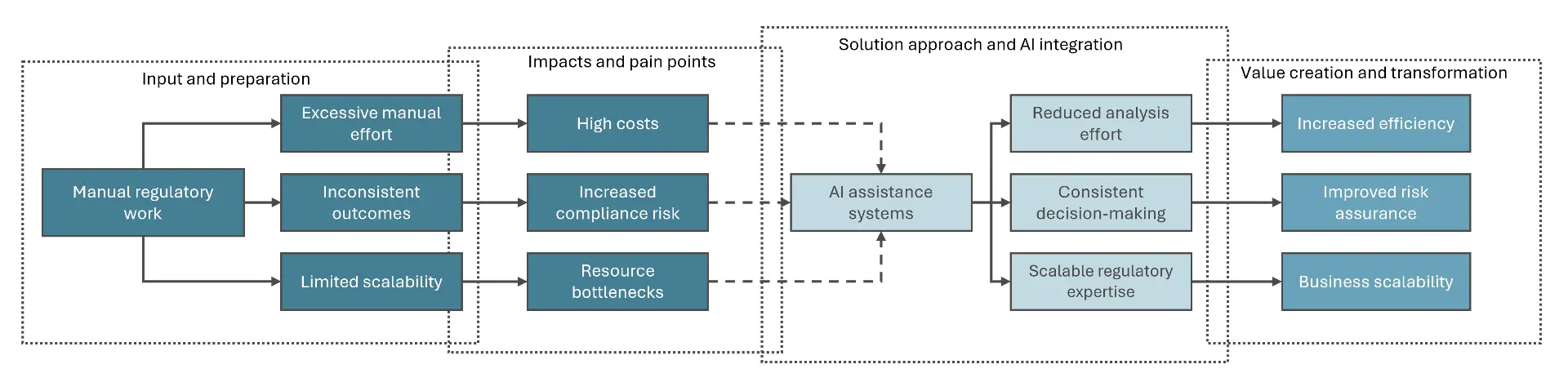
Figure 3: Business value and ROI
AI assistance rather than autonomous decision-making
Discussions surrounding artificial intelligence are often dominated by visions of complete automation. For regulated industries, however, a different approach is far more practical.
The focus should not be on autonomous decision-making, but on controlled AI assistance systems:
- With transparent and traceable processing steps
- With professionally configurable assessment logic
- Within clearly defined operational boundaries
- Under explicit human accountability
This creates a form of auditable AI support that better aligns regulatory requirements, governance principles, and practical applicability.
For regulatory processes, the availability of extensive general knowledge is not necessarily the decisive factor. In many cases, the relevant sources, such as regulations, internal policies, and control requirements, already exist in a structured format. The true value therefore lies in the ability to analyze, compare, and evaluate this information consistently and transparently.
This opens the door to a variety of future operating models, ranging from cloud-based solutions to sovereign, locally operated AI architectures.
Conclusion
The greatest value of modern AI systems does not primarily lie in generating generic content, but in providing structured support for recurring cognitive professional processes.
Regulatory activities such as audit preparation, gap analyses, compliance assessments, and internal audit reviews offer significant potential for AI-supported assistance approaches.
The key prerequisites for sustainable success are structured analytical processes, traceable workflows, professionally configurable assessment methodologies, and the close integration of human expertise.
This enables organizations not only to make regulatory processes more efficient, but also more consistent, scalable, and manageable, while improving the planning and execution of controls and audits.